
I’ve enjoyed close relationships with a great many elderly folk over the course of my life. And I have learned so many things from them all. I’m writing today about one of those things – the value experience has to education.
So, this post is not about aging, it’s about the role of experience in our learning process. But I’m recognizing that I am a bit conflicted here, because that’s kind of what aging is. Our experiences in time and space add up with each becoming part of the body of knowledge we possess at any given journey marker we arrive at. Any formal, supervised classroom type instruction we receive along the way is always only going to be part of the bigger school of life curriculum. Some words from Mark Twain come to mind. He said he never allowed his schooling to interfere with his education. Got to love the man.
You have to admit, when we use the word education, our minds typically go to the institutional version of the idea – a formal, established, academic pursuit with accreditation, and a report card of some kind, all leaning heavy on abstract information, logic and reason. And yet, the kind of learning that is shaped by experience, though requiring us to think (obviously), is much more than that. Experiencing something tangibly even has the power to increase our understanding of the idea of the thing in the abstract. Because that’s the way our minds work, from concrete to abstract; from the real thing to the idea of it. This is why, historically speaking, languages (words) formed out of tangible life experiences. But that might be another topic for another day.
When you learn something by experience you learn it on a different level.
I remember staring at a handout in shop class in grade seven (we called it ‘Industrial Arts’ here in those days). It was a diagram like this one with all the parts of a hand plane. I think we had to memorize it and were tested on it.
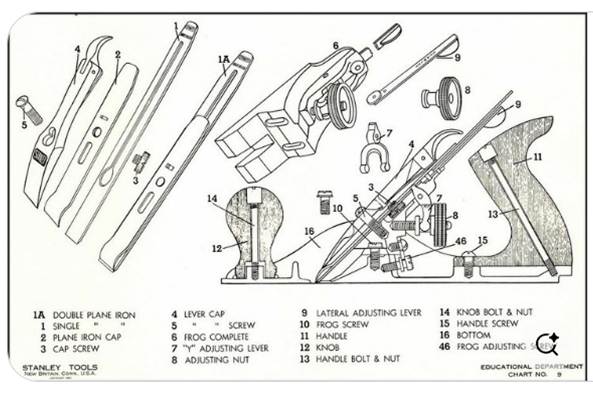
Looking back on it now it was not unimportant information – what a ‘frog adjusting screw’ is for example! But the moment you reach out your arm and take hold of a hand plane, feel its weight and its balance in your hand, then make that difficult push to guide the cut of its blade along a nice piece of pine, forming it long and even, well, that’s learning about hand planes on a very different level. You might say it takes the learning to a different plane. (couldn’t resist that one) After all, the above diagram is only a drawing. It’s not the real thing! And you only get to engage with it in your mind.
None of this is to say that one type of learning exceeds or supersedes the other or anything like that. They represent different types of learning that form an education. Both things are essential and probably should be considered interdependent. We may at times be tempted to think that the latter is more essential than the former. A guy walks out of trade school (or law school) and walks onto the job site (or office building) and commences to tell everyone already there (some since the guy was in diapers) how to do their jobs. It’s not good to be just ‘book smart’. None the less, the information gained from academic study is critically important too. Not only can it save us from disaster, not to mention a lot of trial and error … grief … regret …
But part of the challenge I face in putting these thoughts to paper today is that I’m attempting to point at something that is so obvious we miss it much of the time. We struggle to see the forest for the trees. Until we experience something personally, our knowledge of it remains abstract, more academic. As someone has said, experience is where we learn the truth by experiencing the truth of it. I like that. It gives a grand tip of the hat to the existence of truth. Truth exists and its principles are woven into the foundational fabric of Creation. The truth is how all of Creation actually exists (what we call reality) and how it all works or is supposed to work.
That is not a short course.
Is there some kind of take-away here? Let’s see, maybe this is a post about aging after all! Why for thousands of years were young people taught to respect their elders? Could it be for the one thing they have that we lack – life experience.
“Paradoxical as it may seem, to believe in youth is to look backward; to look forward we must believe in age.” Dorothy L. Sayers
“Pure logical thinking cannot yield us any knowledge of the empirical world . All knowledge of reality starts from experience and ends in it .”
Albert Einstein
Great blog! Reality can only be defined by experience ( I feel anyhow personally.)..either collectively or subjectively. Both logic and experience in our older generations is pure Gold when they are integrated together. Their knowledge is like when they put Peanut butter and chocolate together…Peanut butter is good …chocolate is good…together wow! pure bliss.. Probably why we value and look up to the opinion of people older than us, from a very young age, all throughout life. They are that mixture.We want to BE the peanut butter cup. Exception of the ages between 12 and 19yrs..of course ..😁that’s a whole other blog
Thanks again for the blog its thawing out my February brain freeze..start getting the juices flowing again…Isn’t that spring Sunshine wonderful! Imagine only ever having the logical knowledge of that one! Yikes. 1 strong point for Empirical !
🌞
Thanks so much for your comments, Andrea. You are delightful. And another great quote that I hadn’t seen before too. Thank you so much.
In honour of Dr.Seuss Day:
“The more that you read, the more things you will know.
The more things you will learn, the more places you will go.”
Dr. Theodor Geisel Seuss
Hard to beat the advice of the good doctor!