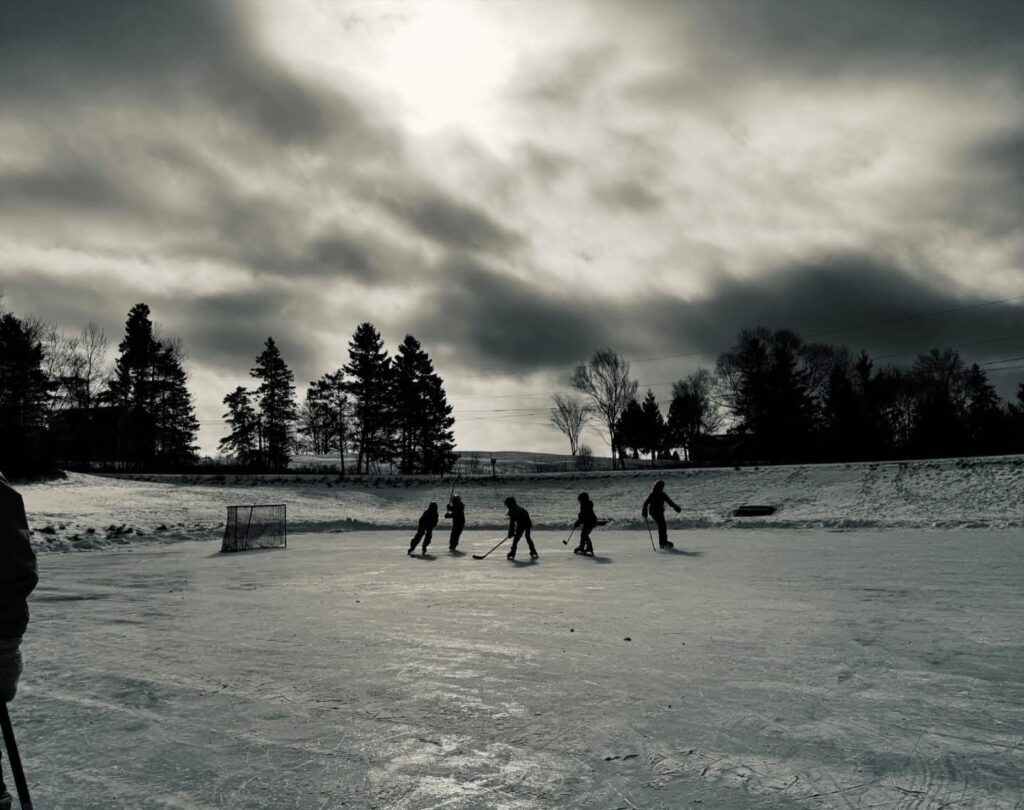
An amazing friend of mine who is also an amazing photographer took this photo. When I look at it I am transported back in time to my childhood growing up in rural Canada. When I was a kid we knew the location and condition of every pond within a five mile radius of home. I can remember Saturday mornings early, walking a mile up the road and another half mile through a snowy field, meeting with friends, pushing the snow off the pond with snow scoops that we shouldered along with our gear (in those days our gear typically consisted of skates, stick, and a puck). Then playing hockey with our friends for hours and hours until the sun was low in the sky. We didn’t even pack a lunch most times, sustained by our passion for the game until we dragged our butts home cold, wet, and entirely spent, to a wonderful home cooked supper (what some insist on calling dinner) and to bed. It was wonderful times.
It’s Canadian. Living in a cold weather climate. The true north strong and freezing! It’s a basic statistical reality – most people don’t live where the air hurts your face. More importantly, where you don’t have to worry about freezing to death. We do. Such talk could sound boastful, like “we’re tougher than you guys” kind of talk. But what I find myself pondering are the ways we are formed culturally by our environment.
How does the rugged northern climate in our part of the world shape us? You don’t hear as much about it these days, probably in large part due to advances in technology that have changed our situation greatly, but when I was in grade school this was a big deal. We learned about Samuel De Champlain and The Order of Good Cheer (L’Ordre de Bon Temps) established by him in 1606 just down the Valley here at Port Royal (Champlain founded Quebec City on the Saint Lawrence two years later). It is said to have been “a social club designed to fight scurvy and improve morale through feasts during the harsh winter.” I would be inclined to add the descriptor ‘long’ to that description of our winters. We learned about the survival ethos that permeated the Canadian culture growing out of those early days of the European settlers. It was considered an important part of our education, a vital aspect of our common identity, our relationship with the land. Short stories in our ‘readers’ included tales of shipbuilding and sailing and fishing and trapping, the life of those early settlers, the exploits of the Voyageurs, the fur trade, the Hudson’s Bay Company, and so much more; all set in a vast wilderness of ever present danger.
Robert Service’s The Cremation of Sam McGee, published in 1907 in Songs of a Sourdough was often committed to memory. Margaret Atwood’s book Survival: A Thematic Guide to Canadian Literature was published in 1972 and used in schools.
Another part of this was the fact that everyone in those days, excepting the native peoples of course, began their Canadian experience with a perilous trip across the North Atlantic leaving home and family behind (permanently for most). How were people shaped by that common experience?
These stories are now hundreds of years behind us, and technological advances have multiplied exponentially in my lifetime. For example, when I was a kid even, every house was heated with wood. Getting your firewood together for next winter (at least) was one of many critical chores that had to be seen to and stories of people freezing to death were not uncommon. I remember winter trips to the outhouse before we had indoor plumbing, so I have a fairly strong sense of the changes that have happened during my time in this part of the world.
But my fascination is not so much with new technology. I am very fond of hot and cold running water, and not opposed to a flight south to the tropics about now, but what I wonder about is how developing technology develops us. So much has changed and we have changed.
Of course, there are many factors affected by technology that impact our lives and shape us as a people that aren’t directly related to climate but where and how we live. According to the U.S. Census Bureau, in the year 1800, 94 percent of the U.S. population lived in rural (agricultural) settings. Today, more than 80 percent of Americans live in cities. And I am sure these statistics are consistent with the Canadian landscape as well. How have those changes affected our culture! Safe to say, more than the weather. A few weeks back I was reading The Lord is My Shepherd by David Gibson and on page 30 Gibson quotes Harold Kushner:
“God’s world, decorated in blues and greens, calms us, gently bathing our eyes with quiet, low-intensity colors. We spend so much of our lives in a man-made environment, with its artificial lighting and artificial cooling and heating, bright neon signs and colour television programs, that when we get a day off … we instinctively feel the need to find our way to God’s world with its more restful palette.”
Physical challenges are overcome opening up all kinds of new opportunities to survive and thrive. However the weather remains a regular topic of conversation still where I live. It’s not inconsequential, even with all our modern conveniences. In Nova Scotia, the news is the weather a great deal of the time with highways and airports and power-grids all battlegrounds for the elements still.
Another memory; I’m back at the pond, not the same pond but a much larger one, a reservoir. The night is clear and cold. The stars are doing what stars are meant to do. The frigid air causes your face to tingle, a marvelous sensation as you glide off, away from the warm light of the bonfire into the magical moonlight with your friends. I remember.
Most of the skating that people do these days happens inside. The development of facilities and the transportation we have today represent great gains for our quality of life. But with every gain we make we do lose something. It’s the way it is. The way it has to be, whether it’s 1606 or 2026. Whether you live in rural Nova Scotia or Timbuktu.
Nostalgia grows as we grow older. We remember simpler days with fondness even as the harsher parts fade in our memories. This too is the way it is. But a lot of what we miss (lose) is the connection we have with Creation; this physical world that we are a part of. And in the process do we in some way lose connection with our own selves? More and more we live more in a virtual reality, less and less grounded. Unless, perhaps, we intentionally do something about that and “find our way to God’s world.”
This very reason is why I need my ocean reset a few times a month.!…year round…
It is a complete separation from all things life on land crowds your head with .No wifi under the Sea!…you are completely in tune with the motion of the water….it’s inhabitants (plant and animal) and everything in between under there! And of course survival…restricted visibility and oxygen sources keeps that fore front in the mind as well. (Usually…:)…)Certainly not preoccupied with returning an email.
Jacque Cousteau famously said
“The Sea. Once it casts its spell , holds one in it’s net of wonder forever ”
I relate my nostalgia not so much to skating but to the sea…Growing up family trips clam digging , picnicking and treasure hunting on the shore and under the waves..swimming…swimming and more swimming….and then (and still now) wondering….what’s under there? What secrets do you keep?
I pray that during this crazy lightning fast pace we are evolving technologically , we never lose our Wonder!.
* side note…I firmly believe anyone with a second hand store or yardsale addiction had a beginning near the Sea….ALWAYS looking for treasures… was the gateway drug…
** I blame my mother..lol jk mom**
Thanks for another great read Steve!
Andrea
Fascinating, Andrea. And I appreciate your thoughtfulness throughout your response. I have to confess though that I hadn’t really thought about swimming in the ocean as a way to interact with the environment in February! Haha. You’re some girl! Thank you for your thoughts.
So many memories, so many years, so many winters. I loved skating in the open air on ponds – my mind goes to playing hockey on a pond down the “mile stretch”, probably where the new hwy 104 is at exit 10. And playing hockey and taking Jenny in a sled to the pond out towards Lornevale. The weather doesn’t seem to be in our favour these days to skate outside (never mind our age!). I love the history you included in your article, also how we lived as kids – time was never an issue. Winter was just another season to play in, but also home life always called us to do chores – like getting the firewood and shoveling the driveway, as well as knocking on doors in hopes of earning a few dollars removing snow from doorsteps and driveways. Now we have tractors and those make short work of snow clearing! So much has been denied this generation, don’t you think?
But I do have to say that travel to warmer climes in the dead of winter has been a gift to me! How I have missed that this year (as well as the people we enjoy there!). I don’t need to travel to “find my way to God’s world”, I can get there in my “Arizona Room” here in Seafoam as He meets me there during my daily devotional time.
I enjoyed this writing, Steve, and hope to see more of it! Thanks.
So much I could say, Glen. I know the pond of which you speak! Thank you for sharing some memories. ❤️
Childhood memories of Canadian kids, love it.
I’m a relative newcomer to Nova Scotia, and I have to admit I find the winters here, more bearable than the ones I grew up with in the Yukon. The farther north you live in Canada, the longer and harsher the winters seem. I love that winter doesn’t really start here in NS till late December, early January. 🙂
True enough, Peter! The farther north you go, the longer the winter is. I think the weather here is also tempered by the maritime breezes and I’m glad it isn’t longer than it is.